Showing posts with label History. Show all posts

Sunday, March 08, 2009

Today is the International Women's Day

History of International Women's Day: International Women's Day has been observed since in the early 1900's, a time of great expansion and turbulence in the industrialized world that saw booming population growth and the rise of radical ideologies.

1908
Great unrest and critical debate was occurring amongst women. Women's oppression and inequality was spurring women to become more vocal and active in campaigning for change. Then in 1908, 15,000 women marched through New York City demanding shorter hours, better pay and voting rights.

1909
In accordance with a declaration by the Socialist Party of America, the first National Woman's Day (NWD) was observed across the United States on 28 February. Women continued to celebrate NWD on the last Sunday of February until 1913.

1910
n 1910 a second International Conference of Working Women was held in Copenhagen. A woman named a Clara Zetkin (Leader of the 'Women's Office' for the Social Democratic Party in Germany) tabled the idea of an International Women's Day. She proposed that every year in every country there should be a celebration on the same day - a Women's Day - to press for their demands. The conference of over 100 women from 17 countries, representing unions, socialist parties, working women's clubs, and including the first three women elected to the Finnish parliament, greeted Zetkin's suggestion with unanimous approval and thus International Women's Day was the result.

1911
Following the decision agreed at Copenhagen in 1911, International Women's Day (IWD) was honoured the first time in Austria, Denmark, Germany and Switzerland on 19 March. More than one million women and men attended IWD rallies campaigning for women's rights to work, vote, be trained, to hold public office and end discrimination. However less than a week later on 25 March, the tragic 'Triangle Fire' in New York City took the lives of more than 140 working women, most of them Italian and Jewish immigrants. This disastrous event drew significant attention to working conditions and labour legislation in the United States that became a focus of subsequent International Women's Day events. 1911 also saw women's 'Bread and Roses' campaign.

1913-1914
On the eve of World War I campaigning for peace, Russian women observed their first International Women's Day on the last Sunday in February 1913. In 1913 following discussions, International Women's Day was transferred to 8 March and this day has remained the global date for International Wommen's Day ever since. In 1914 further women across Europe held rallies to campaign against the war and to express women's solidarity.

1917
On the last Sunday of February, Russian women began a strike for "bread and peace" in response to the death over 2 million Russian soldiers in war. Opposed by political leaders the women continued to strike until four days later the Czar was forced to abdicate and the provisional Government granted women the right to vote. The date the women's strike commenced was Sunday 23 February on the Julian calendar then in use in Russia. This day on the Gregorian calendar in use elsewhere was 8 March.

1918 - 1999
Since its birth in the socialist movement, International Women's Day has grown to become a global day of recognition and celebration across developed and developing countries alike. For decades, IWD has grown from strength to strength annually. For many years the United Nations has held an annual IWD conference to coordinate international efforts for women's rights and participation in social, political and economic processes. 1975 was designated as 'International Women's Year' by the United Nations. Women's organisations and governments around the world have also observed IWD annually on 8 March by holding large-scale events that honour women's advancement and while diligently reminding of the continued vigilance and action required to ensure that women's equality is gained and maintained in all aspects of life.

2000 and beyond
IWD is now an official holiday in China, Armenia, Russia, Azerbaijan, Belarus, Bulgaria, Kazakhstan, Kyrgyzstan, Macedonia, Moldova, Mongolia, Tajikistan, Ukraine, Uzbekistan and Vietnam. The tradition sees men honouring their mothers, wives, girlfriends, colleagues, etc with flowers and small gifts. In some countries IWD has the equivalent status of Mother's Day where children give small presents to their mothers and grandmothers.

The new millennium has witnessed a significant change and attitudinal shift in both women's and society's thoughts about women's equality and emancipation. Many from a younger generation feel that 'all the battles have been won for women' while many feminists from the 1970's know only too well the longevity and ingrained complexity of patriarchy. With more women in the boardroom, greater equality in legislative rights, and an increased critical mass of women's visibility as impressive role models in every aspect of life, one could think that women have gained true equality. The unfortunate fact is that women are still not paid equally to that of their male counterparts, women still are not present in equal numbers in business or politics, and globally women's education, health and the violence against them is worse than that of men.

However, great improvements have been made. We do have female astronauts and prime ministers, school girls are welcomed into university, women can work and have a family, women have real choices. And so the tone and nature of IWD has, for the past few years, moved from being a reminder about the negatives to a celebration of the positives.

GoogleAnnually on 8 March, thousands of events are held throughout the world to inspire women and celebrate achievements. A global web of rich and diverse local activity connects women from all around the world ranging from political rallies, business conferences, government activities and networking events through to local women's craft markets, theatric performances, fashion parades and more.

Many global corporations have also started to more actively support IWD by running their own internal events and through supporting external ones. For example, on 8 March search engine and media giant Google some years even changes its logo on its global search pages. Year on year IWD is certainly increasing in status. The United States even designates the whole month of March as 'Women's History Month'.

So make a difference, think globally and act locally !! Make everyday International Women's Day. Do your bit to ensure that the future for girls is bright, equal, safe and rewarding.

Friday, April 04, 2008

This day in history

April 4, 1975: Bill Gates, Paul Allen Form a Little Partnership


Microsoft founders Bill Gates and Paul Allen in 1983 just after completing MS Dos for the Tandy laptop and signing a contract to write MS-DOS for IBM.
Photo: Doug Wilson/Corbis

1975: Bill Gates and Paul Allen create a partnership called Micro-soft. It will grow into one of the largest U.S. corporations and place them among the world's richest people.

Gates and Allen had been buddies and fellow Basic programmers at Lakeside School in Seattle. Allen graduated before Gates and enrolled at the University of Washington. They built a computer based on an Intel 8008 chip and used it to analyze traffic data for the Washington state highway department, doing business as Traf-O-Data.

Allen went to work for Honeywell in Boston, and Gates enrolled at Harvard University in nearby Cambridge. News in late 1974 of the first personal computer kit, the Altair 8800, excited them, but they knew they could improve its performance with Basic.

Allen spoke to Ed Roberts, president of Altair manufacturer MITS (Micro Instrumentation and Telemetry Systems), and sold him on the idea. Gates and Allen worked night and day to complete the first microcomputer Basic. Allen moved to Albuquerque, New Mexico, in January 1975 to become director of software for MITS. Gates dropped out of his sophomore year at Harvard and joined Allen in Albuquerque.

Allen was 22; Gates was 19. Altair Basic was functioning by March. The "Micro-soft" partnership was sealed in April, but wouldn't get its name for a few more months.

The fledgling company also created versions of Basic for the hot-selling Apple II and Radio Shack's TRS-80.

Microsoft moved from Albuquerque to Bellevue, Washington, in 1979. It incorporated in 1981, a few weeks before IBM introduced its personal computer with Microsoft's 16-bit operating system, MS-DOS 1.0.

The thriving young company moved again in 1986, this time to a new corporate campus in Redmond, Washington. Microsoft stock went public in March 1986. Adjusting for splits, a share of that stock is worth almost 280 times its original value today (or more than 140 times, even accounting for inflation).

Wednesday, March 12, 2008

Bangladesh war of independence in 1971

Bangladesh 1971

They had risked all to hold on to this moment in history. The scarred negatives, hidden from the military, wrapped in old cloth, buried underground, also bore the wounds of war. These photographers were the only soldiers who preserved tangible memories, a contested memory that politicians fight over, in their battle for supremacy. These faded images, war weary, bloodied in battle, provide the only record of what was witnessed. Nearly four decades later, they speak.

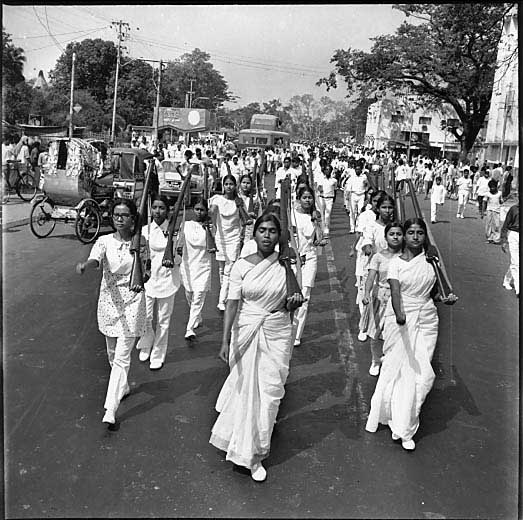
women-marching-in-streets-of-dhaka-in-1971-1152.jpg

Women marching in the streets of Dhaka. 1971. © Rashid Talukder/Drik/Majority World

A photographic exhibition and film season that focuses on one of South Asia’s most significant political events: the foundation of Bangladesh as an independent state.
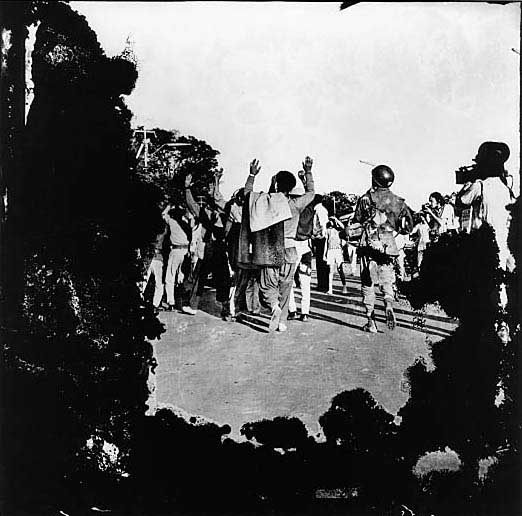
pakistani-soldiers-surrendering-aftab-ahmed-1161.jpg Pakistani soldiers surrendering on the 16th December 1971. © Aftab Ahmed/Drik/Majority World

The Bangladesh war of independence in 1971 was one of the bloodiest conflicts in living memory. In an attempt to crush forces seeking independence for what was then East Pakistan, the West Pakistani military regime unleashed a systematic campaign of violence that resulted in the deaths of thousands of Bangalis. Many of the photographs from the unique collection of the Drik archives will be shown in the UK for the first time.

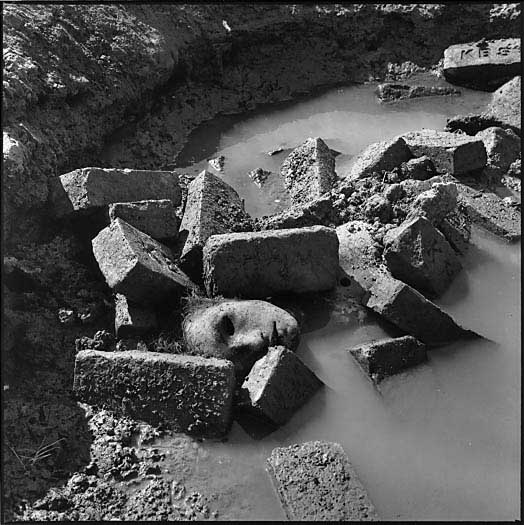
dismembered-head-in-rayerbajar-rashid-talukder-1111.jpg Dismembered head at the Rayerbajar Killing Fields where intellectuals were slaughtered on the 14th December 1971 © Rashid Talukder/Drik/Majority World

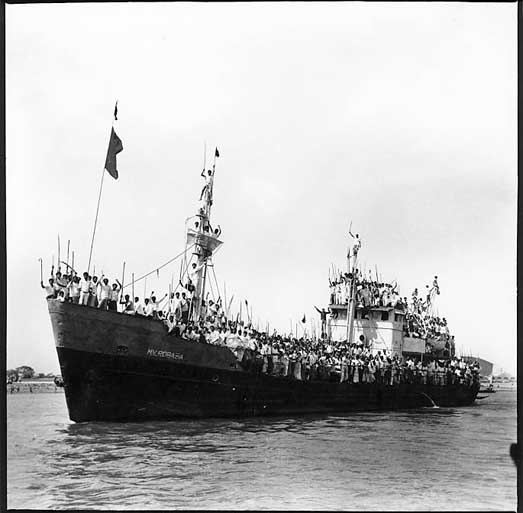
victorious-muktis-returning-home-523.jpgVictorious Mukti Bahini returning home at the end of the war. © Jalaluddin Haider/Drik/Majority World

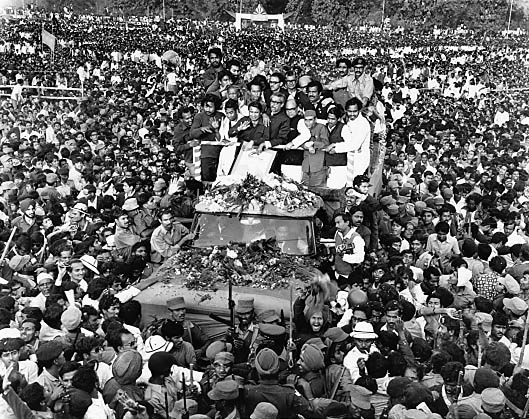
mujib-returns-to-bangladesh.jpg Sheikh Mujibur Rahman on his return to Bangladesh from Pakistan. 10th January 1972 © Rashid Talukder/Drik/Majority World

In 266 days Bangali, hill people and Adivasi resistance fighters and their allies defeated the military forces of Pakistan. The result was the birth of a new nation - Bangladesh - and the dismemberment of Pakistan.
It was only after the 16th of December 1971 when Pakistani troops surrendered in East Pakistan, that Bangladeshis began to realise the scale of the atrocities committed during the previous nine months.

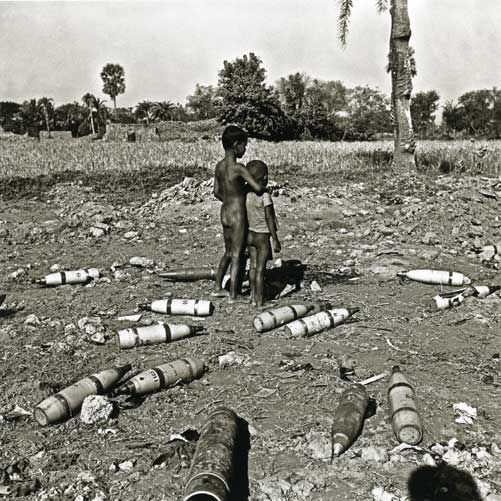
children-and-shells.jpg Children amidst shells. © Abdul Hamid Raihan © Rashid Talukder/Drik/Majority World

1971 was a year of national and international crisis in South Asia. The history of Bangladesh is implicitly tied to the partition of India in 1947 and therefore the tragic events of 1971 are linked to Britain’s colonial past. For Bangladesh, ravaged by the war and subsequent political turmoil, it has been a difficult task to reconstruct its own history. It is only during the last few years that this important Bangladeshi photographic history has begun to emerge.

Now decades after the war, Autograph ABP in collaboration with Drik presents a historical photographic overview of Bangladesh 1971 at Rivington Place.

Project Description
A major documentary photographic exhibition of primarily Bangladeshi photographers that focuses on the independence struggle in 1971. The exhibition is produced in partnership with Shahidul Alam, Director of Drik, a media activist and journalist from Bangladesh. This will be the first comprehensive review in the UK of one of the most important conflicts in modern history. It is recognised that over a million people died in 266 days during the struggle for an independent Bangladesh.

UK partner Autograph ABP. Curator Mark Sealy, director of Autograph ABP.

Exhibition open to public April 4th – 31st May 2008
Press View - Both curators will be available to meet the press 11.30am – 1pm April 3rd

The exhibition is accompanied by the Bangladesh 1971 Film Season throughout April 2008 in partnership with Rich Mix and The Rainbow Film Society. Please see attached document for full details.

For further information or images, contact Indra Khanna 020 7749 1261 or David A Bailey 020 7749 1264.
Autograph ABP, Rivington Place, London EC2A 3BA.

Notes:

VENUE
Rivington Place
off Rivington Street
London EC2A 3BA
020 7749 1240

April 4th – 31st May 2008
Open Tuesday - Friday 11am - 6pm
Saturday 12pm - 6pm
Entry is free. Venue is wheelchair accessible.

• Shahidul Alam: Curator, photographer, activist. Gallery Talk (in Bengali) 2pm April 5th
• Mark Sealy: Director of Autograph ABP. Gallery Talk (in English) 6.30pm April 17th
• Many other talks and events to be confirmed
• Bangladesh 1971 Film Season throughout April 2008 in partnership with Rich Mix and The Rainbow Film Society
• Special screening of documentaries and artists’ films at Rivington Place to be announced

Photographers included in the exhibition: Abdul Hamid Raihan, Aftab Ahmed, BegArt Collection, Golam Mawla, Jalaluddin Haider, Mohammad Shafi , Naib Uddin Ahmed, Rashid Talukder, Sayeeda Khanom and Bal Krishnan.